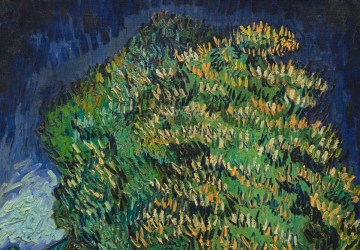





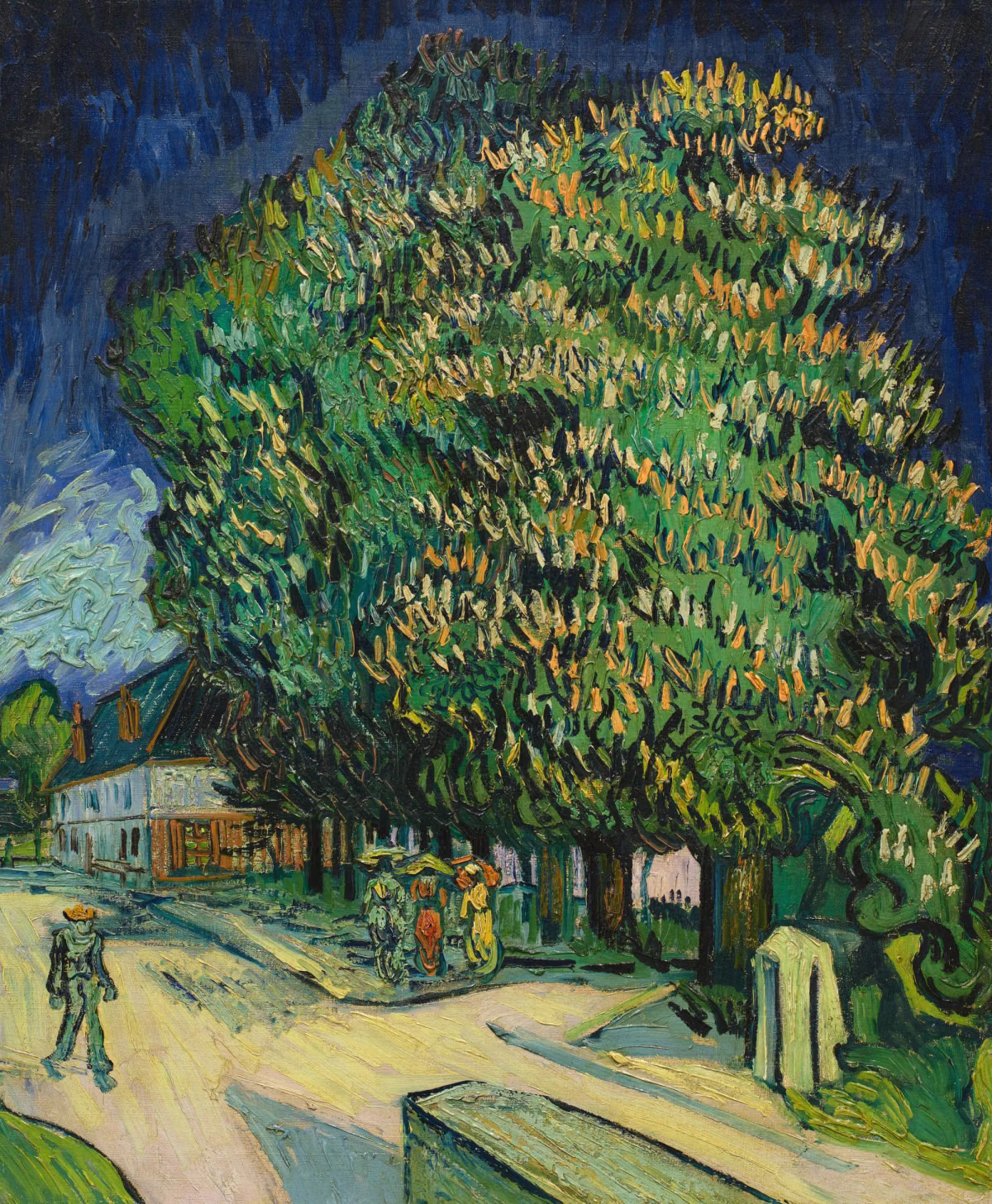

A flowering street scene painted during Vincent van Gogh’s final months has become one of the most closely watched works of the autumn auction season. Blossoming Chestnut Trees, also known as Châtaigniers en fleurs, carries a reported estimate of around US$180 million ahead of Sotheby’s planned sale in New York on 18 November.
The painting’s return to public view follows more than six decades away from exhibitions. Its sale has also drawn a new challenge from heirs of a former owner, adding scrutiny to an already remarkable ownership history.
A street scene from Van Gogh’s final spring
Sotheby’s dates the oil painting to 24 May 1890, shortly after Van Gogh arrived in Auvers-sur-Oise, northwest of Paris. He had left Saint-Rémy-de-Provence and was beginning an intensely productive period in the village.
Measuring 70 by 58 centimetres, the canvas places flowering chestnut trees above a street populated by small figures. Dense foliage and pale blossoms rise against a deep blue sky, while women carrying parasols pass beneath the canopy.
In a letter to his brother Theo dated 25 May, Van Gogh mentioned completing a study of chestnut trees. The Art Newspaper connects that reference to this painting, situating it within the artist’s first days in Auvers.
From the artist’s family to an Argentine collection
After Van Gogh’s death, the painting passed to Theo and subsequently to Johanna van Gogh-Bonger and Vincent Willem van Gogh. Sotheby’s provenance records a succession of dealers and collectors, including the Prince de Wagram, Gustave Fayet and Berlin publisher Samuel Fischer.
Fischer acquired the work in 1909. It passed to Brigitte and Gottfried Bermann-Fischer in 1934, before being sold through the Amsterdam dealer Paul Cassirer in 1936.
Later owners included Hollywood songwriter and producer George “Buddy” Gard DeSylva and New York collector Harriet Harris-Jonas. The Blaquier-Arrieta family acquired it in 1975.
Its last recorded public exhibition before the current auction presentation was Van Gogh and Expressionism at New York’s Solomon R. Guggenheim Museum in 1964.
Why the estimate attracts attention
The reported US$180 million figure is an anticipated hammer price, rather than a completed transaction. The Art Newspaper calculates that buyer’s fees could bring the total to approximately US$207 million if bidding reaches that level.
That would exceed Van Gogh’s auction record of roughly US$117.2 million, including fees, achieved by Orchard with Cypresses at Christie’s in 2022.
The work is offered within a group of 12 paintings from the Blaquier-Arrieta collection, collectively expected to raise around US$450 million. Other artists represented include Cézanne, Monet, Renoir, Degas, Gauguin and Pissarro.
Sotheby’s lists the Van Gogh’s estimate as available on request and identifies it as guaranteed property. Neither designation establishes what bidders will ultimately pay.
A disputed chapter in its ownership history
Days before the scheduled auction, heirs of the Fischer family asked Sotheby’s to withdraw the painting. They argue that the 1936 sale occurred under duress linked to Nazi persecution and the resulting damage to the family’s publishing business.
Sotheby’s said its research had not established that the painting was sold under duress. The auction house also confirmed discussions with the heirs and said it was seeking a mutually satisfactory resolution.
The claim concerns the circumstances of that historical transaction. The painting remains listed in Sotheby’s catalogue for the 18 November sale, with no auction result yet available.