



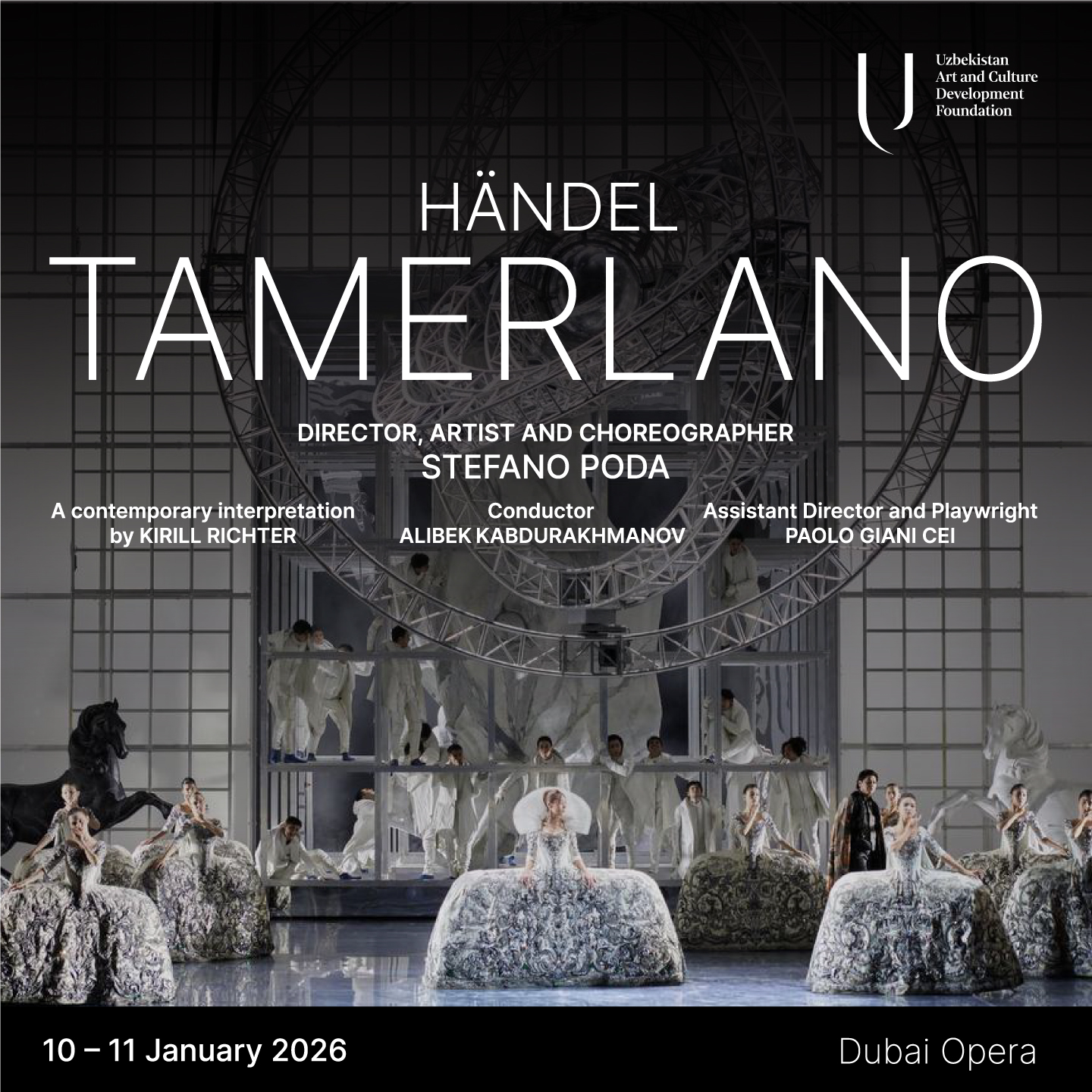
Dubai is preparing to open its 2026 cultural calendar with an operatic statement designed to be anything but conventional. On January 10 and 11, Dubai Opera will present the world premiere of a new production of George Frideric Handel’s Tamerlano—a staging that arrives with the ambition of an international event and the scale of a large-format spectacle.
At the center of the project is Italian maestro Stefano Poda, whose signature approach is described as a “revolutionary stage vision,” one that re-reads Handel’s Baroque masterpiece through a lens of Central Asian mysticism and monumental imagery. If traditional opera often relies on inherited visual codes—period costumes, historicized décor, and predictable dramaturgy—this production signals a deliberate break from that logic. It proposes a different question: not how faithfully we can reproduce an era, but how boldly we can reimagine its emotional and philosophical core.
The numbers alone point to the scale. The production brings 160 performers to the stage, combining the Uzbekistan National Symphony Orchestra, leading international soloists, and ballet—an unusually expansive ensemble for a Handel opera, typically known for its precision, ornamentation, and intimate psychological tension rather than overwhelming mass. Here, the promise is a fusion: the compositional brilliance of Handel’s music aligned with a visual world built for contemporary audiences accustomed to cinematic intensity.
Handel’s Tamerlano is, at its heart, an opera about power—its seductions, its humiliations, and its cost. The story draws on the historical aura of Tamerlane, the conqueror whose name still carries the weight of myth. In many productions, the drama plays out as a refined political chess match: rulers and prisoners, revenge and negotiation, private anguish contained within courtly form. Poda’s staging, however, is positioned as something more expansive—an “epic legend” told through bold scenography and “innovative visual solutions,” transforming the stage into an immersive narrative environment rather than a framed tableau.
That promise matters in Dubai, a city whose cultural identity is increasingly defined by its ability to host global firsts. Dubai Opera has become a crossroads where classical repertoire meets modern production values, and where audiences are not limited to one tradition of viewing or listening. This premiere fits that trajectory: a work rooted in the European canon, presented through a staging concept that reaches outward—toward Central Asia’s symbolic landscapes and spiritual textures—suggesting a dialogue between histories rather than a single linear narrative.
The production’s creators emphasize the experience of scale: “every episode astonishes,” “every scene redefines what opera can be.” Journalistically, such declarations are best read not as conclusions, but as intentions—an invitation to audiences to arrive with curiosity, and perhaps with a willingness to be unsettled. Because the most interesting operatic evenings are rarely the ones that confirm what we already believe. They are the ones that challenge the contract between stage and spectator: the familiar becomes unfamiliar, and the past feels unexpectedly present.
In practical terms, what makes this event notable is its combination of elements: a canonical Handel title, a director/maestro with a strong visual philosophy, a large multinational performance force, and an institutional partnership that expands the project’s cultural footprint. The production is supported by the Uzbekistan Foundation for the Development of Culture and Arts, signaling that this is also a cultural showcase—an opportunity to bring Uzbekistan’s artistic resources into one of the world’s most visible stages, and to present them in a context that highlights both tradition and contemporary ambition.
For the audience, the appeal will likely be twofold. For opera lovers, there is the draw of Handel’s music—its dramatic architecture, its vocal virtuosity, its emotional exactness. For a broader public, there is the staging’s promise of a sensory event: monumental sets, a large ensemble, choreography, and visual storytelling meant to feel “entirely unexpected.” In an era when cultural institutions compete not only on excellence but on urgency, this premiere positions itself as an occasion—two nights framed as a once-only moment when something new enters the repertoire.
Whether it truly “transcends genre” will be decided in the live encounter, in the quiet seconds when the hall holds its breath and music meets image. But the intention is clear: January 10 and 11 are being framed not simply as performances, but as a high-profile cultural milestone—one that invites Dubai to witness an opera not as museum art, but as living, evolving theatre.
Tickets are available at Dubai Opera.
The production is supported by the Uzbekistan Foundation for the Development of Culture and Arts.